
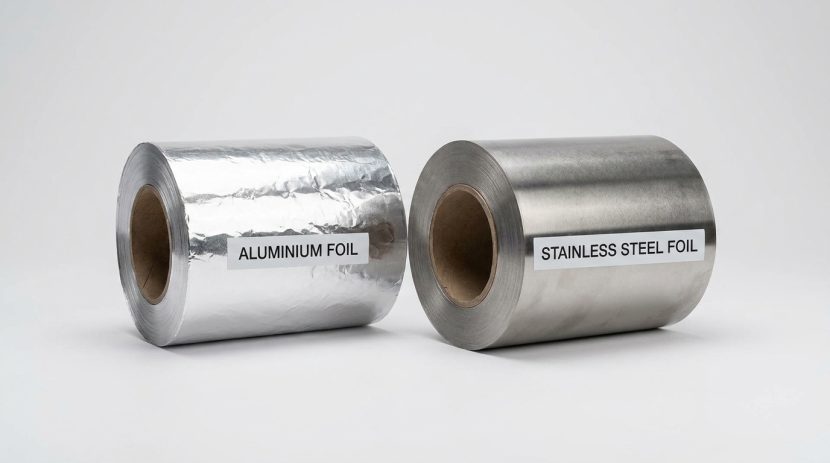
When selecting foil materials for industrial applications, choosing the right option goes beyond comparing prices. The material you choose directly influences product durability, manufacturing efficiency, maintenance costs, and overall operational performance.
In Malaysia, industries such as electronics, automotive, food processing, medical manufacturing, and precision engineering rely on high-performance materials that can withstand demanding environments. While aluminium foil remains a practical choice for lightweight and disposable applications, stainless steel foil in Malaysia has become the preferred solution for businesses that require exceptional strength, corrosion resistance, and long-term reliability.
This guide provides an in-depth comparison of aluminium foil and stainless steel foil, helping manufacturers, engineers, procurement professionals, and industrial buyers make informed purchasing decisions.
Aluminium Foil vs Stainless Steel Foil: Quick Comparison
| Feature | Aluminium Foil | Stainless Steel Foil |
| Weight | Lightweight | Heavier but significantly stronger |
| Strength | Moderate | Excellent tensile strength |
| Corrosion Resistance | Good | Excellent |
| Heat Resistance | Moderate | Outstanding |
| Thermal Conductivity | Excellent | Moderate |
| Durability | Lower | High |
| Initial Cost | Lower | Higher |
| Long-Term Value | Suitable for short-term use | Better lifecycle value |
| Common Industries | Packaging, insulation | Manufacturing, aerospace, electronics, medical |
Although both materials are manufactured into thin sheets, they are designed for different purposes. Understanding these differences helps businesses select the most suitable material for their operating environment.
What Is Aluminium Foil?
Aluminium foil is produced by rolling aluminium into thin sheets, offering excellent flexibility and thermal conductivity. Because it is lightweight and easy to shape, it is widely used across consumer and industrial applications.
Its affordability makes it one of the most commonly used foil materials worldwide.
Typical applications include:
- Food and beverage packaging
- Pharmaceutical blister packaging
- HVAC insulation
- Household cooking foil
- Cable wrapping
- Disposable containers
- Light-duty heat shields
For applications where structural strength is not critical, aluminium foil provides an economical and practical solution.
What Is Stainless Steel Foil?
Stainless steel foil is manufactured by rolling stainless steel alloys into precision thin gauges while retaining their mechanical strength and corrosion-resistant properties.
Unlike aluminium, stainless steel maintains excellent structural integrity even in harsh operating conditions, making it suitable for industries where reliability cannot be compromised.
Today, stainless steel foil in Malaysia is widely used across industries such as:
- Electronics manufacturing
- Automotive production
- Aerospace engineering
- Medical equipment manufacturing
- Battery production
- Semiconductor components
- Industrial filtration
- Chemical processing
- Heat exchangers
- Precision springs and gaskets
Its durability makes it an ideal material for applications requiring long service life and consistent performance.
Aluminium Foil vs Stainless Steel Foil: Key Performance Differences
1. Strength and Mechanical Performance
Mechanical strength is often the deciding factor in industrial applications.
Aluminium foil is relatively soft and can easily bend, tear, or deform under pressure. While this flexibility is advantageous for packaging, it limits its suitability for demanding engineering applications.
In contrast, stainless steel foil in Malaysia offers exceptional tensile strength while maintaining dimensional stability under repeated stress.
| Performance | Aluminium Foil | Stainless Steel Foil |
| Tensile Strength | Moderate | High |
| Wear Resistance | Fair | Excellent |
| Puncture Resistance | Moderate | Excellent |
| Structural Stability | Low | Excellent |
| Reusability | Limited | High |
For components exposed to vibration, pressure, or mechanical loading, stainless steel foil provides significantly greater reliability.
2. Corrosion Resistance
Malaysia’s tropical climate presents unique challenges due to high humidity, heavy rainfall, and coastal exposure.
Aluminium naturally forms an oxide layer that offers reasonable corrosion protection. However, prolonged exposure to saltwater, chemicals, or acidic environments can gradually degrade its performance.
Stainless steel performs considerably better under these conditions.
Grades such as 304 and 316 stainless steel provide excellent resistance to corrosion, making them suitable for marine environments, food processing facilities, and chemical plants.
Businesses looking for durable stainless steel foil in Malaysia often prioritise corrosion resistance because it directly reduces maintenance costs and extends equipment lifespan.
3. Heat Resistance
Both materials conduct heat effectively, but their temperature limits differ significantly.
Aluminium transfers heat quickly, making it useful for cooking, insulation, and heat distribution.
However, stainless steel maintains its mechanical strength at much higher operating temperatures while resisting oxidation and thermal deformation.
This makes stainless steel foil the preferred material for:
- Industrial ovens
- Automotive exhaust systems
- Heat exchangers
- Thermal shields
- Furnace components
- High-temperature processing equipment
For continuous high-temperature environments, stainless steel offers greater operational reliability.
4. Weight and Flexibility
One of aluminium foil’s greatest advantages is its low weight.
Its flexibility allows it to wrap around complex surfaces with ease while reducing transportation costs.
Stainless steel foil is heavier, but advances in precision rolling technology allow manufacturers to produce ultra-thin stainless steel foil without compromising strength.
For industries requiring lightweight materials with maximum durability, selecting the appropriate foil thickness becomes more important than simply comparing overall weight.
5. Cost vs Long-Term Value
Many buyers initially focus on purchase price.
While aluminium foil generally costs less upfront, industrial purchasing decisions should also consider lifecycle costs.
| Cost Factor | Aluminium Foil | Stainless Steel Foil |
| Initial Purchase Cost | Lower | Higher |
| Maintenance Requirements | More frequent | Lower |
| Replacement Frequency | Higher | Lower |
| Service Life | Shorter | Longer |
| Long-Term Value | Moderate | Excellent |
Although stainless steel foil in Malaysia typically requires a higher initial investment, its durability often results in fewer replacements, reduced downtime, and lower maintenance expenses over time.
For many industrial applications, this translates into a better return on investment.
Industry Applications in Malaysia
Both materials play important roles across Malaysian industries, although they serve different operational requirements.
| Industry | Aluminium Foil Applications | Stainless Steel Foil Applications |
| Food Processing | Packaging, wrapping | Processing equipment, heat shields |
| Electronics | EMI shielding | Precision components, battery materials |
| Automotive | Heat insulation | Exhaust systems, gaskets, springs |
| Construction | Thermal insulation | Expansion joints, architectural components |
| Medical | Pharmaceutical packaging | Surgical instruments, medical devices |
| Chemical Processing | Limited applications | Corrosion-resistant equipment |
| Manufacturing | Protective wrapping | Precision engineering components |
As Malaysia continues expanding its advanced manufacturing and electronics sectors, demand for precision stainless steel materials continues to grow.
Expert Insight
Selecting industrial materials should never be based solely on upfront cost. Engineers and procurement professionals should evaluate operating temperature, corrosion exposure, expected service life, maintenance requirements, and total cost of ownership. In many demanding industrial environments, stainless steel foil delivers greater long-term value by reducing equipment downtime and replacement frequency.
Which Material Should You Choose?
The best material depends on your application requirements.
| Choose Aluminium Foil If… | Choose Stainless Steel Foil If… |
| Cost is your primary concern | Long-term performance is the priority |
| Lightweight materials are required | High strength is essential |
| The product is disposable | The component will be reused |
| Operating temperatures are relatively low | High-temperature resistance is required |
| The environment is dry and non-corrosive | The application involves moisture, chemicals, or marine exposure |
| Flexibility is more important than strength | Structural stability is critical |
If your application requires durability, reliability, and consistent performance under demanding operating conditions, stainless steel foil is generally the better long-term investment.
Why Choose Stainless Steel Foil in Malaysia?
Industrial buyers increasingly seek suppliers capable of delivering precision materials that meet international quality standards.
High-quality stainless steel foil in Malaysia offers several advantages:
- Excellent corrosion resistance for humid and marine environments
- High mechanical strength for demanding applications
- Reliable performance at elevated temperatures
- Long service life with reduced replacement frequency
- Precision thickness for consistent manufacturing
- Suitable for industries requiring strict quality control
Working with an experienced supplier also ensures access to the correct stainless steel grade, foil thickness, surface finish, and technical support based on your specific application.
Final Thoughts
Both aluminium foil and stainless steel foil have their place in modern manufacturing and industrial applications.
Aluminium foil remains an excellent solution for lightweight, flexible, and cost-sensitive applications such as packaging, insulation, and disposable products. However, when strength, corrosion resistance, temperature performance, and long-term durability are essential, stainless steel foil in Malaysia provides a more dependable solution.
Rather than selecting materials based solely on initial cost, businesses should evaluate the total cost of ownership, operating conditions, and expected product lifespan. By choosing the right foil material for your application, you can improve manufacturing efficiency, reduce maintenance costs, and enhance overall product performance.
As Malaysia’s manufacturing sector continues to advance, investing in high-quality stainless steel foil is a strategic decision that supports operational reliability and long-term business success.
Need Help Choosing the Right Foil Material?
Every industrial application has unique performance requirements. Whether you’re selecting foil for heat resistance, corrosion protection, precision manufacturing, or long-term durability, choosing the right material can improve efficiency and reduce operating costs.
If you’re exploring stainless steel foil in Malaysia for your next project, consult an experienced supplier who can recommend the appropriate grade, thickness, and surface finish based on your specific application. The right technical guidance can help you achieve better performance, longer service life, and greater value over the lifetime of your equipment.
Frequently Asked Questions (FAQs)
What is the main difference between aluminium foil and stainless steel foil?
The primary difference lies in their performance and intended use. Aluminium foil is lightweight, highly flexible, and cost-effective, making it suitable for packaging, insulation, and disposable applications. Stainless steel foil, on the other hand, offers superior strength, corrosion resistance, and heat resistance, making it the preferred choice for industrial, engineering, and high-performance applications.
Is stainless steel foil stronger than aluminium foil?
Yes. Stainless steel foil has significantly higher tensile strength and is much more resistant to tearing, punctures, and deformation than aluminium foil. This makes it ideal for components exposed to mechanical stress, vibration, or repeated use.
Why is stainless steel foil more expensive than aluminium foil?
Stainless steel foil generally has a higher upfront cost because of its alloy composition and manufacturing process. However, its longer service life, lower maintenance requirements, and greater durability often result in a lower total cost of ownership, especially for industrial applications.
Which material is better for high-temperature applications?
Stainless steel foil is the better choice for high-temperature environments. It maintains its strength and structural integrity under elevated temperatures, while aluminium foil has a lower melting point and is more likely to deform or lose strength when exposed to prolonged heat.
What industries commonly use stainless steel foil in Malaysia?
Stainless steel foil is used across a wide range of industries, including:
- Electronics and semiconductor manufacturing
- Automotive production
- Aerospace engineering
- Medical device manufacturing
- Food processing
- Chemical processing
- Battery manufacturing
- Industrial filtration
- Precision engineering
Its versatility makes it a valuable material for applications requiring durability and precision.
Disclaimer:
The information provided in this article is intended for general informational purposes only. It does not constitute professional advice nor does it represent the full scope of services offered by Shyn Tech Enterprise Sdn. Bhd.
Readers are encouraged to consult a qualified industry professional or contact our team for recommendations tailored to their specific project requirements. While we strive to ensure the accuracy and reliability of the content published on our website, we cannot guarantee that all information is error-free or complete. Shyn Tech Enterprise Sdn. Bhd. assumes no responsibility for any inaccuracies, omissions, or decisions made based on the information provided.