
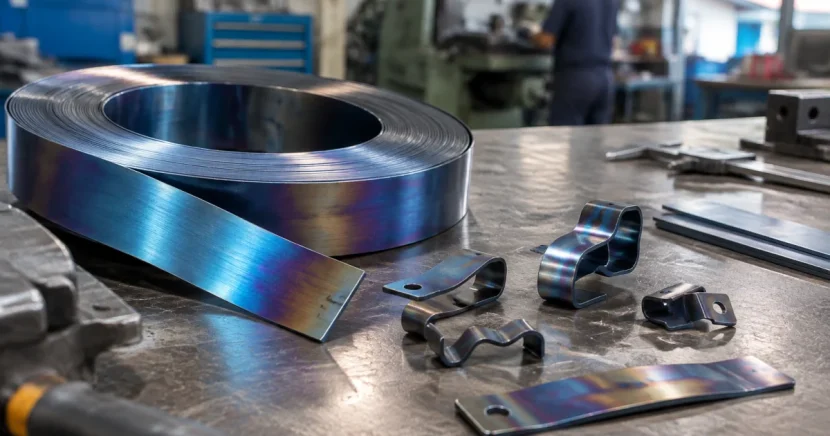
Small-run manufacturing rewards materials that are predictable, available, and forgiving when you need to cut, form, and assemble parts without long iteration cycles. In Malaysia, blue tempered spring steel is often the “workhorse” choice for clips, washers, light springs, retainers, and simple spring tooling components. It generally forms consistently and is commonly obtainable in practical quantities.
This is an opinionated guide grounded in everyday shop realities rather than a universal rulebook. For many small batches, blue tempered spring steel is a practical starting point because it balances performance with procurement and fabrication convenience. But it’s not a magic material—and in common Malaysian contexts (humidity, washdown, outdoor exposure, high temperatures, tight corrosion requirements), you should deliberately choose something else.
If you’re also comparing other shop materials (shim stock, stainless grades, or heat-treatment consumables such as toolwrap malaysia), the goal is the same: reduce trial-and-error by clarifying when this material fits and where it doesn’t.
What “blue tempered” spring steel really means in practice
Blue tempered spring steel is typically high-carbon steel strip/plate supplied in a hardened-and-tempered condition. The “blue” is an oxide tint from tempering; the real takeaway is the delivered condition: spring behavior is available from stock without requiring in-house heat treatment for many applications.
For small runs, that matters because heat treatment adds variables (distortion, scale, hardness variation) and lead time. Starting from spring-tempered stock can remove an entire process step—or reserve heat treatment only for parts that truly need it. It also simplifies communication: when you specify “blue tempered spring steel,” most tool & die and stamping shops picture the same material category, reducing the risk of ordering the wrong thing.
Why it’s a strong default for small-run manufacturing in Malaysia
Small runs often fail for practical reasons: late material, wrong thickness, inconsistent forming, or rework because parts are too soft (set) or too brittle (crack). Blue tempered spring steel helps reduce several of these risks when used in the right context.
1) It’s usually easier to prototype quickly
Prototypes and short batches benefit from materials that cut and form using common methods—shearing, laser cutting, stamping, bending, and simple forming tools. Spring-tempered strip is a known quantity, so you can validate geometry and spring action sooner, then refine edge finishing, radius, and forming sequence instead of restarting with a new alloy strategy.
2) It supports thickness-driven design decisions
Many small-run spring components are thickness-limited: stiffness, preload, and deflection are highly sensitive to thickness. That makes available thickness and repeatability key buying criteria—one reason people compare “spring plate” and “shim plate” categories.
If the job is primarily precision spacing (alignment, bearing preload, machine leveling) rather than elastic deflection, you may not need spring material. In that case, focus on shim materials and selection logic via A Practical Guide To Buying Stainless Steel Shim In Malaysia.
3) It’s cost- and process-efficient for “good enough” corrosion environments
Many indoor factory uses are not truly corrosive—more like “occasionally oily, occasionally humid.” In those scenarios, blue tempered spring steel (paired with sensible oiling, coating, or enclosure design) can be a rational compromise. In many small-run projects, the first real constraint is forming consistency and lead time rather than corrosion.
4) It’s a practical fit for maintenance and small-run repeat orders
Maintenance teams often need replacement springs, clips, and retainers quickly in quantities of 2, 10, or 50. Sourcing from a supplier that supports small-run purchasing without heavy minimums helps keep downtime manageable. A local Malaysian supplier also makes it easier to confirm thickness, stock forms, and workable substitutes without long import cycles.
For reference, listings like Shim Stock Spring Plate Blue can help you sanity-check common forms and thickness ranges used for short-run work.
Where blue tempered spring steel can disappoint (and what to choose instead)
The common mistake is assuming “spring steel” automatically means “best spring.” The best spring material depends on environment, fatigue demands, manufacturing method, and what failures you can tolerate. Below are situations where blue tempered spring steel is often not the practical choice.
1) When corrosion resistance is non-negotiable
For washdown areas, marine exposure, outdoor equipment, or aggressive cleaning chemicals, spring-tempered carbon steel can rust quickly. In these cases, stainless spring steel (or other corrosion-resistant alloys) is usually the better long-term decision, even if forming and cost are less friendly.
Also watch for “hidden” corrosion: trapped moisture in assemblies, components near coolant splash, or enclosed equipment that cycles temperature and condenses water.
2) When you need high-temperature performance
Blue tempered spring steel has limits at elevated temperatures. Near furnaces, heaters, or prolonged high-heat service, spring properties may degrade and oxidation can accelerate—often pushing you toward stainless or high-temperature alloys.
If your workflow includes heat treatment, don’t confuse spring material selection with consumables used to protect parts in a furnace. Stainless foil/tool wrap addresses oxidation, scaling, and decarburization during heat treatment and is a separate decision. If you’re evaluating that side, 7 Benefits Of Using Stainless Steel Tool Wrap For Heat Treatment helps keep the decisions distinct.
3) When tight fatigue life is the whole point
For high-cycle parts (continuous vibration, high stroke counts, critical safety function), the right answer may be a more controlled alloy and processing route. Depending on design, you may need shot peening, defined surface finish, strict deburring standards, or a specific stainless spring grade. Blue tempered spring steel can still work, but it becomes less forgiving: edge condition, notch sensitivity, and forming radii must be controlled. In small runs, that process discipline can cost more than upgrading the material.
4) When your process is sensitive to burrs and micro-cracks
Short-run fabrication often uses flexible cutting methods (laser, waterjet, EDM for complex shapes, or quick stamping dies). Spring-tempered steel is sensitive to edge defects; a cut edge that’s acceptable in mild steel may crack during forming or fail early in service here. If consistent deburring and edge-finishing capability isn’t in place, consider either upgrading material/process or simplifying the spring element.
For very fine features, a common strategy is to keep the functional spring element simple in spring steel and move complex geometry into a non-spring carrier component made from a more machinable material.
How to choose for small runs: a practical decision checklist
Treat blue tempered spring steel as a starting hypothesis, then run a checklist that reflects small-run realities in Malaysia: limited time, limited MOQ tolerance, and a need for predictable outcomes.
- Environment: Indoor and lightly oiled, or exposed to water/coolant/chemicals? If exposure is real, evaluate stainless spring options early.
- Operating temperature: Ambient, warm, or high heat? If heat is involved, separate “spring material” decisions from “heat treatment protection” decisions.
- Required deflection and preload: Higher stress magnifies edge quality and forming radius sensitivity.
- Fabrication method: Cutting method and edge finish matter. Plan deburring and controlled radii; don’t rely on “we’ll clean it up later.”
- Thickness availability: Stiffness is often dominated by thickness. Confirm the supplier can repeatedly supply the thickness you prototype with.
- Quantity and repeatability: For frequent small reorders, prioritize supplier responsiveness and consistent stock forms.
If you’re stuck between categories—spring steel vs spring plate vs shim plate—use a structured comparison: Spring Steel Vs Spring Plate Vs Shim Plate Differences Uses How To Choose.
My opinionated take: where it’s “practical,” and where it’s false economy
Blue tempered spring steel is practical in small-run Malaysian manufacturing when:
- you need reliable spring action quickly without building a full heat-treat workflow,
- the part runs in controlled indoor conditions,
- the geometry is simple enough to control edge quality and forming radii, and
- you’re optimizing for speed-to-first-article and manageable purchasing quantities.
It becomes a false economy when:
- corrosion will drive early replacement or field failures,
- operating temperature will degrade spring properties,
- fatigue life is mission-critical and surface/edge conditions can’t be controlled, or
- your process creates burrs or micro-cracks you can’t reliably remove.
Many factories also benefit from procurement flexibility: using one supplier for spring steel, shim stock, stainless options, and specialty items reduces delays when a project shifts from spring design to spacing, alignment, wear, or EDM needs (for example, copper tungsten/tungsten copper electrodes). The key is not forcing one material to solve every problem, but choosing the right one quickly for the dominant failure mode.
Conclusion: use blue tempered spring steel deliberately, not automatically
For small-run manufacturing in Malaysia, blue tempered spring steel is often practical because it’s a ready-to-use spring material that supports fast prototyping and repeat orders without demanding a full metallurgical process chain. That’s why it remains popular for clips, retainers, washers, and light spring components.
But the boundaries matter as much as the benefits. If corrosion, heat, or fatigue life is truly dominant, moving to stainless spring material or another suitable alloy is often cheaper than repeated rework and premature replacements. The best small-run outcome is usually the one that reduces iteration cycles: confirm the environment, confirm thickness, control your edges, and select the material that matches the failure you can’t tolerate.
Frequently Asked Questions
Is blue tempered spring steel suitable for precision clips and washers in small batches?
Often yes. For many clips, retainers, and washer-like spring elements, blue tempered spring steel provides usable spring properties straight from stock, which helps small batches move quickly. The main cautions are edge quality (deburring matters) and the operating environment—if moisture, coolant, or chemicals are present, stainless spring options may be more reliable long term.
When should I choose stainless spring steel instead of blue tempered spring steel?
Choose stainless spring steel when corrosion resistance is a core requirement (washdown areas, marine exposure, outdoor equipment, or frequent chemical cleaning). It can also be the better choice when oxidation at elevated temperature is a concern. The trade-off is typically higher material cost and, depending on grade and thickness, more demanding forming and finishing.
How do I decide between spring steel, spring plate, and shim plate for a job?
Start with the function. If you need elastic deflection and return force, you’re in spring steel/spring plate territory. If you need accurate spacing or alignment with minimal deflection, you’re usually looking for shim plate or shim stock. Thickness tolerance, surface finish, and availability in the exact thickness you need are often the deciding factors for small-run work.
What is stainless steel tool wrap, and is it related to spring steel selection?
Stainless steel tool wrap (also called stainless foil wrap) is used to protect parts during heat treatment by reducing oxidation, scaling, and decarburization. It’s a separate decision from choosing spring steel for clips or springs. You might buy both in the same project—spring steel for the component and foil/tool wrap for furnace processing of other parts—but they solve different problems.
What information should I provide a supplier to quote blue tempered spring steel for a small run?
Provide thickness, width/length (or required cut size), quantity, preferred form (strip, sheet, or plate), and the intended fabrication method (stamping, laser cut, bending). If the part is sensitive to corrosion or heat, share the operating environment so the supplier can suggest stainless spring alternatives or other grades. For repeatability, ask whether the same thickness and form can be supplied consistently for future reorders.
Need small-run spring steel or related engineering materials in Malaysia?
Shyn-Tech Enterprise Sdn. Bhd. supports prototypes, maintenance jobs, and short production runs with no MOQ for many items. If you’re deciding whether blue tempered spring steel is right for your clips, washers, or spring components—or if you need complementary materials like shim stock, stainless grades, copper tungsten, or heat treatment foil/tool wrap—share your thickness, size, and application. We’ll help you narrow down a practical option for your process and lead time.
Disclaimer:
The information provided in this article is intended for general informational purposes only. It does not constitute professional advice nor does it represent the full scope of services offered by Shyn Tech Enterprise Sdn. Bhd.
Readers are encouraged to consult a qualified industry professional or contact our team for recommendations tailored to their specific project requirements. While we strive to ensure the accuracy and reliability of the content published on our website, we cannot guarantee that all information is error-free or complete. Shyn Tech Enterprise Sdn. Bhd. assumes no responsibility for any inaccuracies, omissions, or decisions made based on the information provided.